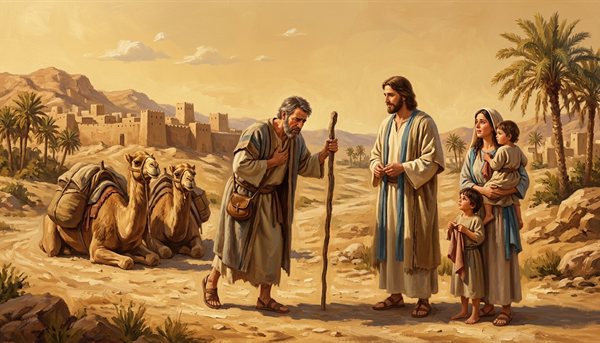
A Day with Jesus
Translated from Romanian.
Morning found me on the road, with the dust still cold under my soles and the light only just learning to fall straight. I leaned on my staff every time the weight of my body shifted onto my left leg. The pain had risen into my hip, and the stabbing in my spine seemed sharper than ever. I breathed heavily, my chest tight, as if the air were harder to carry into my lungs. I was lost in thought, imagining how the day that had only just begun would unfold.
Beyond the hill with the flattened brow, the path began to open out. If I had calculated correctly, I should reach Jericho around midday. I could hear the faint clinking of the denarii in the purse tied to my belt, and I pictured the two camels I wanted to buy. I had been to the merchants' city a few times before, but since the accident I had avoided exhausting journeys. The crack of splintering wood and the neighing of frightened horses had followed me every day since, without exception. My nights, full of nightmares, had aged me long before time had its say.
On that morning – exactly six years ago now – the carriage overturned without warning, and in an instant my life was split in two. I lost my son and my wife under those heavy wheels, while I remained helpless between the iron and my own scream, with my left leg crushed and my heart broken.
Since then, every journey has been a trial. The staff supports not only my body, but my memories too. When my weight falls on my left leg, I feel not only the stabbing in my hip, but also the emptiness of the house, the heavy silence that greeted me on the evening I came home alone.
So I was heading for Jericho, forcing myself to keep my mind on the market and the two camels. I had done my reckoning: if I bought them at the right time, perhaps I would have a purpose again. Now, however, at this time of year, they were expensive. But I did not care. Work was the only thing that still kept my mind occupied. When you lose everything, you search desperately for something to hold on to.
Several hours had passed since I left home. The wind had risen a little and lifted the dust in small eddies, like restless spirits wandering without rest. After the oasis of date palms, the road widened enough for two carts to pass side by side. A few dozen metres beyond the last tree, where the field opened up, I came upon a crowd of people. At first I did not understand what they were doing there. They moved hurriedly and all talked at once, turning the silence into a restless anthill of voices. I stopped for a moment, leaning harder on my staff. From a distance, the commotion seemed meaningless, a jumble of shouts, calls and questions thrown to the wind. Then, as I came closer, I began to make out sunburnt faces, hands cracked by work, women with babies at their breasts and men girded with thick ropes, a sign that they had left their work unfinished. Some looked towards the centre of the crowd with wide eyes, others elbowed their way forward, determined not to miss anything.
Then I glimpsed an empty circle, like an island of silence in the middle of the noise. In that space stood a man. He was not dressed differently from the others. His simple tunic hung straight, and the dust of the road covered its hem just as it covered mine. I do not know what made me go forward. Perhaps curiosity, perhaps the wish to tear my thoughts away from the past, or perhaps the weariness of being alone with my pain.
- It is the Teacher, whispered an old man beside me, without taking his eyes off him. Jesus of Nazareth.
The name passed through my mind like a warm breeze. I had heard it spoken before. Some said he healed, others that he disturbed the order of things. I had also met people who said he was a simple carpenter. I was not looking for the true version. I wanted to buy the camels and get back home before sunset.
But my legs did not obey my reckoning. I took a few steps and stopped beside a group of men who had raised their hands to the sky and begun to sing an old psalm about the son of the Lord. They had rough voices, worn by wind and dust. It was not a skilful song, but one that came from the chest, broken in places, yet charged with a faith that took the place of harmony. The words floated above our heads like a covenant spoken for centuries. I kept walking, using my staff to clear a path, and the sound of the psalm faded behind me. Ahead, the circle of people opened again. Then I came before Him. And at that moment He raised His eyes. First He finished the sentence He was speaking to those around Him, then, as if He knew exactly where I was, His eyes lifted and rested on me.
That gaze pinned me where I stood.
His face did not have the radiance we attribute to kings. His skin was burnt by the sun, a warm brown, with darker shadows on the cheekbones. It was clear He had walked a great deal under the open sky. His forehead was broad, crossed by fine lines, not from frowning, but from deep thought and constant attention to those around Him.
His hair fell almost to His shoulders, in slightly wavy, dark strands, caught here and there with lighter threads, bleached by the light. He wore it naturally, like a man for whom roads matter more than mirrors. His beard, full but cared for without pretension, framed His mouth and accentuated the calm of His features.
And His eyes...
His eyes could not be compared with anything I had ever seen. Not for their colour – though they had a depth that seemed to swallow the light and give it back more gently – but for the way they looked. They did not pass over you, they did not measure you and they did not judge you. They rested upon you with complete presence, as if at that moment there were no one else on earth.
When He looked at me, I had the strange feeling that all the noises were withdrawing. The murmur of the crowd, the rustle of the palm trees, the restless footsteps – all of them drew away, like waves that break on the shore and then retreat.
In His eyes there was no harshness at all, but no weakness either. There was a quiet, controlled strength that had no need to impose itself. He seemed to see beyond my dusty clothes, beyond the scar on my leg, beyond the years that weighed on me.
His mouth, slightly curved, kept the trace of a gentleness that was not naivety. The corners of His lips had that faint weariness of a man who has listened to too many complaints, yet has not turned away from any of them.
The tunic He wore was simple, woven from thick cloth the colour of pale sand. Over His shoulders fell a light cloak, loosely fastened – a sign that He was ready at any moment to set off on the road again.
I noticed His hands only when He raised them slightly to signal the crowd to be quiet. They were not the hands of a scribe or a merchant. They had the roughness of work, visible tendons, strong fingers with short nails. In them one could see the habit of working wood, of handling heavy things, of supporting fallen bodies. And yet, when they paused for a moment in the air, I discovered an unexpected delicacy, as if they could break a branch but would always choose to caress it.
His stature was imposing not because of His height, but because of His uprightness. He stood straight, but not tense. When our eyes met, I felt that I was being read like a scroll unrolled slowly, with respect for every line. My shame, my anger, my nights full of nightmares – all of them were known to Him.
- You have come, He said.
Not "Who are you?" or "What do you want?" Only the simple observation that my steps had been part of a road He already knew. I dared to come closer, and the crowd drew aside, opening a path for me. I stopped a few paces away, looking at His face lit with gentleness. He spoke my name, pressing on every syllable, and silence fell, as if the whole world had taken a step back to make room for this moment. He knew it, and that astonished me beyond measure. Spoken by Him, it was not just a sound. It was a remembering. For the first time, it had been spoken as it was conceived at the beginning of the world.
He took a step towards me, and the earth under His sandals made not the slightest sound.
- Eliab ben Natal, He said again, more softly.
The moment He spoke my name for the second time, I felt a gentle force entering my body. It was a soothing warmth that spread without haste through every part of my being.
It passed through my arms, through my bones weary from the road, and stopped in my crippled leg. For a moment the pain vanished. Then that warmth rose suddenly, and my heart tightened as if it had recognised something my mind could not yet understand.
I raised my eyes.
His eyes had nothing of the harshness of the judges I had known.
- Do not be afraid, He said.
He took a few more steps. He stretched out His hand and touched my shoulder. The shiver went all the way down to the soles of my feet, and for the first time since the accident I felt the ground under both feet in the same way.
I took one step, then another, without leaning on my staff. The ground was firm under my soles, and every movement was a rediscovery of my own body. The leg that until then had been burden and pain moved without faltering.
I looked at Jesus with tears in my eyes.
He said nothing about a miracle. He did not raise His hands to the sky and did not call upon anyone. He only touched my shoulder, like a brother telling you that the road has not ended.
Soon He set off slowly towards Jericho, and I followed Him. He waited for me to draw level with Him, then smiled at me gently.
- You are a good man, Eliab, son of Natal, He told me. The Heavenly Father loves you. Your faith does you honour.
He looked at the little wooden cross hanging from my neck. Hung on a string knotted in several places, it had worked its way out through my tunic and was now swinging freely. I wanted to answer Him, but I was so overwhelmed by what I was living through in those moments that I could not. Behind us, the crowd began to move. A murmur passed among the people, like the rustle of grass before the wind.
"A miracle, a miracle," came from their chests.
I turned my head and only then realised that with Jesus were the twelve Apostles about whom I had heard so many stories. They were walking behind us, and what astonished me beyond measure was the living light that shone from their eyes. They carried no weapons and wore no costly clothes. They did not guard the Teacher; they only followed Him.
They began to sing, and their voices rose to the sky, spreading a sense of well-being beyond any explanation. The psalms flowed over the road, over the stones, over our footsteps. Some people wept without knowing why. Others repeated the words, as if they had known them since childhood.
I walked in silence.
Every step was a new miracle.
The road went down among reddish rocks and wild fig trees. The sun had climbed the sky, and its light made the dust of the road look like gold.
*
When the walls of Jericho appeared in the distance, the crowd began to thicken. Merchants, children, people in a hurry, camels laden with sacks of wheat and spices. We were approaching a city that lived like a beehive.
I remembered my thought from that morning. I had come to buy two camels. With them I could have traded on the road between Jerusalem and Damascus. But my plans now seemed small, like rusty tools.
I entered the market as soon as I passed under the stone archway, above which soldiers of the Roman Legion were patrolling. The gates were open and tied back, a sign that trade was flourishing in Jericho. The cries of the merchants collided with one another, and I stayed near a stall overflowing with grain, very close to the entrance. When I realised that the disappearance of the pain in my leg was making me carry my staff under my arm, I remembered Jesus. I searched for Him among the people and beasts, through the swarm around me, but I did not see Him. He had disappeared into the depths of the market.
I set off slowly towards the animal pens, watchful of the people around me. The noise of the merchants gradually faded as I went along the streets that separated the trading areas. Soon the lowing of oxen and the deep grunting of camels began to grow louder and louder. The air smelled of warm dust, leather and dry hay. Beyond a corner framed by thick walls and Roman sentries, the paved road ended abruptly, and the first camel pen, bordered by thick wooden stakes, made me stop. The animals knelt in the sand, tied with ropes, swaying their long heads and chewing slowly. An old merchant with a thin white beard sat on a stool, counting some coins.
- Looking for good animals? he asked me without raising his eyes. I have young, strong camels. They can carry you a long way.
I came closer and looked at them. Two of them were big, with long legs – exactly what I had come for. For a moment I already saw myself on the road to Damascus, with sacks of spices hanging from the saddles and the denarii I had earned clinking in my purse. Above all, the miracle Jesus had worked on me filled me with a euphoria I had never known before. I remembered the words of the Apostles who spoke to Him, calling Him the Son of the Lord, and I raised my eyes to the sky, searching the blue of the horizon. For the first time since the accident, I felt alive.
And I would have lingered long in that wonderful world I had slipped into, had I not heard that small, faint crying, almost drowned out by the noise of the animals. Beside one of the posts of the pen, in the shade of a cloth shelter, sat a young woman. Her clothes were simple and dusty, and her hands were tied with a thin rope. In her arms she held a small child, who was crying with his face hidden against her chest.
- Who are they? I asked.
The merchant put the coins away in his pocket, then finally raised his eyes.
- A slave, he said curtly, wrinkling his nose. I bought her this morning, boy and all.
I remained silent.
The child calmed down for a moment, then turned and looked at me. He had large black eyes, and his cheek was dirty with tears and dust.
I felt the wooden staff slipping slightly from under my arm, and I looked at its silver handle – the only valuable thing I had carried with me since the accident.
The merchant got up heavily, then slapped his palm against the wooden fence.
- Well? The camels won't buy themselves.
I untied the purse from my belt and poured the coins into his palm. He weighed them in his hand, then looked me in the eye.
- It's not enough for two camels.
- Not for the camels, I said.
I put the staff down beside the coins as well. The silver of the handle gleamed for a moment in the afternoon sun. I had staked everything on a single throw, without thinking too much.
The dealer raised his eyebrows, looked at the woman and the boy, then turned to me.
- For the slave and the child?
I nodded.
The old man gave a short laugh, waving his hand a few times.
- She's yours, then. Along with the crybaby.
As soon as the merchant cut the rope, the woman picked up the child and came over to me. She handed me the boy between the planks, then she too came out of the pen.
- What will you do with them? the old man asked me.
- I will set them free, I answered.
*
We reached the grain market when the sun was hurrying towards sunset. On the way I carried the boy in my arms, and the young woman walked behind me, not daring to walk alongside me. I respected her way of thanking me. Only when we came close to the stone archway did I stop and ask her name. She answered me gently, raising her eyes to the child who had fallen asleep on my chest.
- My name is Miriam, and the little one is called Natal.
- He has the same name as my father, I said. When we get home, I will let you go.
- We will stay with you, if you allow us, the woman confessed.
A few moments later, I met Jesus for the last time. He appeared among the stalls, and the crowd quickly filled the square. The Teacher stopped beside the same grain stall, near the entrance to Jericho, and smiled at me. He held out His hands and came towards us. He looked at the boy resting against my neck and spoke to me with the same gentleness. I will never forget His words.
- Tell me, Eliab, what did you buy today?
- Them, I answered.
- Listen to a parable, He said, raising a hand.
Silence spread quickly over the square.
- A man found two seeds in the desert. One large and heavy, good for trading. The other small and fragile, but alive. The man chose the living one and put it in the ground. Years later, a tree grew from it, under which many found shade.
Jesus looked at the woman, then again at the child.
- Camels carry burdens for a while. A freed man carries light for a whole lifetime. Today you bought more than two camels, Eliab, son of Natal. You have redeemed two lives.
His words remained in the air, like a silent blessing. Then I understood: sometimes the greatest wealth is not what you gather, but what you set free. And for the first time in many years, I felt that the road ahead of me was lighter than the one I had left behind.